Description
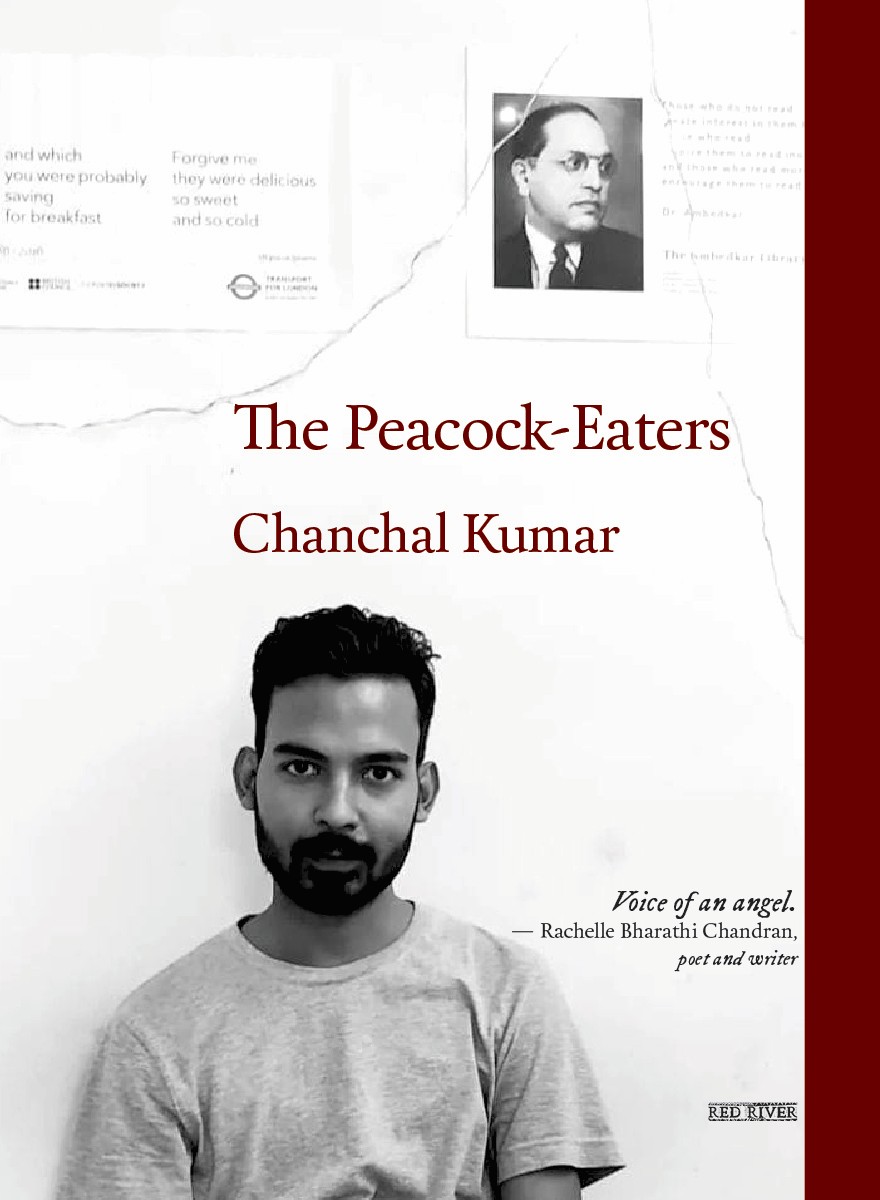
Voice of an angel. — Rachelle Bharathi Chandran, poet and writer
The Peacock-Eaters is an outstanding debut. Indian poetry in English is damn lucky to have a voice such as Chanchal’s. — Akhil Katyal, poet, author of The Last Time I Saw You
The Peacock-Eaters surprised me with its range and effectiveness. There were poems that just tore me deep, poems which never let go of hope, and poems so short and crisp that they stung. This is a remarkable collection. — Hansda Sowvendra Shekhar, novelist, author of My Father’s Garden
As a young Dalit poet writing in English, Kumar has much to contend with, much to counter, displace, and deconstruct before he can form his wholly original poetic worldview. […] Kumar counters these multitudes of cultural, historical, and literary exclusions with aplomb, investing each poem with a nuanced and studied synthesis of both his experiential wisdom and his wide literary-philosophical influences. — Rahee Punyashloka, visual artist and illustrator
At times playful and self-deprecating, at times deadly serious, this is a book you’ll want to read. — Michael Creighton, poet and educator, author of New Delhi Love Songs
Chanchal Kumar recognises poetry is essential, but knows not why, and finds that even the horse’s arse deserves gratitude. A first collection to be read and savoured. — Maaz Bin Bilal, poet and translator, author of Ghazalnama
In Chanchal’s craft is the persuasion to bend language to justice and freedom. Enter these poems to be singed by history and make love by its fire. — Vqueer, poet and activist
Chanchal Kumar is from Dhanbad, Jharkhand in India and received his MPhil degree in English Literature from the University of Delhi. Currently, he is Assistant Professor of English at Vinoba Bhave University, Hazaribag (Jharkhand). He is an Ambedkarite Buddhist.
Reviews
An excerpt from ‘The Peacock-Eaters’ in Scroll
FROM THE BOOK
†
In the Introduction to Sartre’s Nausea
The writer asserts that Camus was more religious than Sartre
which made me think,
it is true that being religious is
more than just counting beads on a rosary
or offering prayers five times a day?
Religion can also be meant to describe
being in awe of tomorrow,
waiting for a new day
to believe that no apocalypse will hit us just yet, just today.
Religion could be more than
what our grandmothers practised with elan, perhaps
or different from what our grandfathers
hunched over a holy book.
A friendly circular stone to prevent its cover
from fluttering in the breeze would describe —
religion can also be meant to say that.
I expect to see you return.
I pray to see us reenact those sessions that we had
beside the parking lot again,
I with a cigarette, you moving your hand
to capture a wandering sentiment.
†
The Peacock-Eaters
†
Remember the time when Nani told me the story of the fledgling peacock which found a way to their home when it was young and how when the peacock was old enough, made into meat for the family. When I tell you the story now, you tell me to narrate the anecdote as she first told me in the book I was writing, as a way to remember her.
†
Babasaheb Is Waiting for His Visa
†
I’m thinking of the man behind the icon
Of the fight before the victory
Of the child before the legend
I’m trying to understand a seeker’s life in retrospect
A man rocking away in his wicker chair
Donning his Mayfair dinner jacket
Learning to play the violin,
The polyglot, the bodhisattva,
Whose speech was like the firing of pistol shots
‘The Most Hated Man in India’
The implacable realist who loved to read
Who liked to paint
From the facts of his life I try to glean
A fistful of inspiration, an ounce of verve and make
A monument of love
What garden did you tend
That the flowers from its boughs
Are still blooming, fragrant in the morning air?
How am I supposed to repay the debt
That accumulates like fine dew in January?
Who am I if not a pulse in your shadow,
A twinkle of your eternal starlight?
Let the turmoil of words around you cease
So that I can say with pride —
You are my history, my today and
All the days I am yet to see.


