Description
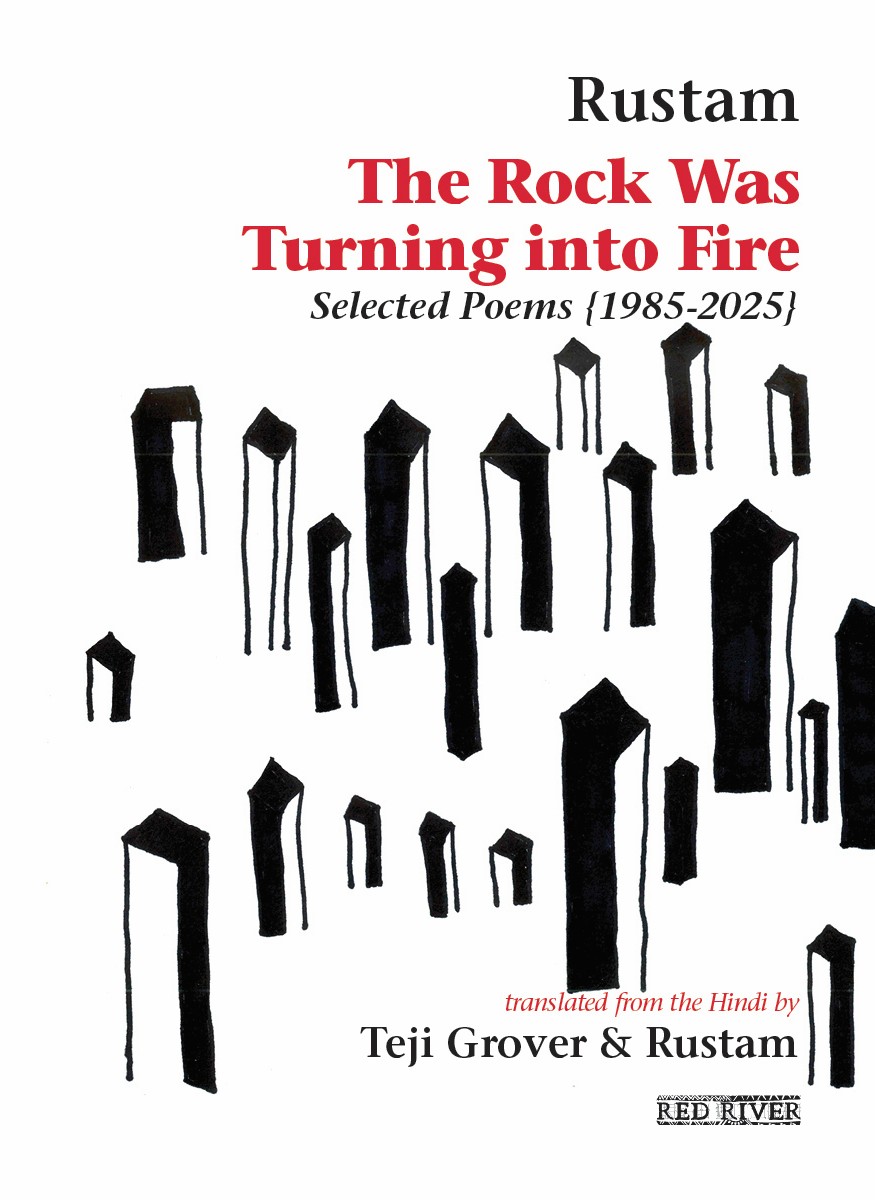
Rustam is a poet with a rare wavelength. His calm, clear and concise sentences create an atmosphere of slightly eerie intensity. His visions tempt one to look over the edge, into the depth of nothingness, sensing distant echoes of Beckett or Chirico. — Doris Kareva, well-known European and Estonian poet
These poems demand solitary meditation from us, because their structure and beauty are extraordinary. Often rich in soft rhythm and inner heat, these poems are like an unlikely event in contemporary Hindi poetry. — Arun Kamal, senior Hindi poet
There comes a stage in literary pursuit when words start melting, meaning is no longer desired, it takes some other shape. Experiences that are inaccessible to words start taking form. The poet, Rustam, has been walking on this path. — Arun Dev, poet and editor of Samalochan
These poems by Rustam are the poems of a man who is deeply troubled with the insurmountable reality of human life, a man who has struggled against and has finally become disenchanted with this reality. As he says in one of his poems, this is a reality which gods have long since abandoned — disappointed that they created this reality and crying at the state of the human world. — Madan Soni, prominent Hindi critic
Rustam Singh (b 1955), who writes poetry under the name Rustam, has published nine collections of poems in Hindi and a volume of his selected poems (2021). He has also published four books in English, under the name Rustam Singh, including Literature, Philosophy, Political Theory: Selected Essays (2022). He has translated into Hindi selected poems of Norwegian poets Olav Hauge (2008) and Lars Amund Vaage (2014). He has also translated into Hindi an anthology of poems of seven Panjabi poets (2022) and (with Teji Grover) selected poems of the Estonian poet Doris Kareva (2022). In addition, he has translated five other books into Hindi. Further, he has edited an anthology of eighteen contemporary Hindi poets (2025). He has held various research and editorial positions including the following: assistant editor of Economic and Political Weekly, Bombay; research associate at Centre for the Study of Developing Societies, Delhi; fellow at Indian Institute of Advanced Study, Shimla; editor of Summerhill IIAS Review, Shimla; founding editor of Hindi: Language, Discourse, Writing, New Delhi/Wardha; visiting scholar at Jawaharlal Nehru University, New Delhi; and senior fellow and senior editor at Eklavya Foundation, Bhopal. Before all this, he was a Captain in the Indian army.
Born in Panjab in, 1955, Teji Grover is a Hindi poet, fiction writer, translator and painter. She is an important voice in Hindi poetry in the generations born after 1950. She has published several collections of poetry, a novel, a collection of short stories, a collection of essays and a book of auto-fiction. Her poetry, fiction and essays have been translated into many Indian and foreign languages and have been widely published in journals across the world. Her novel Neela has been published in Polish and English translations, and her collected fiction was published in English translation in 2020. A volume of her selected poetry was published in 2019 in Swedish translation. She has also been widely anthologised as a poet. As a painter, she has exhibited her works in several galleries both home and abroad. She has developed her own repertoire of ecological colours extracted from natural substances, and shares her knowledge widely for environmental reasons. Teji Grover has introduced some of the most significant modern Scandinavian writers and poets to the Hindi reader, such as Knut Hamsun, Tarjei Vesaas, Jon Fosse, Kjell Askildsen, Gunnar Björling, Hans Herbjørnsrud, Edith Södergran, Tomas Tranströmer, Lars Lundkvist, and Ann Jäderlund, among many others, as also the French writer Marguerite Duras, the Latvian writer Nora Ikstena and the Estonian poet Doris Kareva. She has received the following awards and fellowships: Bharat Bhushan Agrawal Award for poetry (1989); Writer-in-Residence/Director, Premchand Srijanpeeth, Ujjain (1995-1997); Senior Fellowship (Literature), Department of Culture, Ministry of Human Resource Development, Government of India, New Delhi (1995-1997); Sayed Haider Raza (SH Raza) Award for poetry (2003); Fellowship at the Institute of Advanced Study, Nantes, France (2016-2017); and Vani Foundation Distinguished Translator Award (2019). She was created Dame by the King and the Queen of Sweden (2019), receiving The Royal Order of the Polar Star, Member 1st Class, for promoting literary and cultural relations between India and Sweden.


