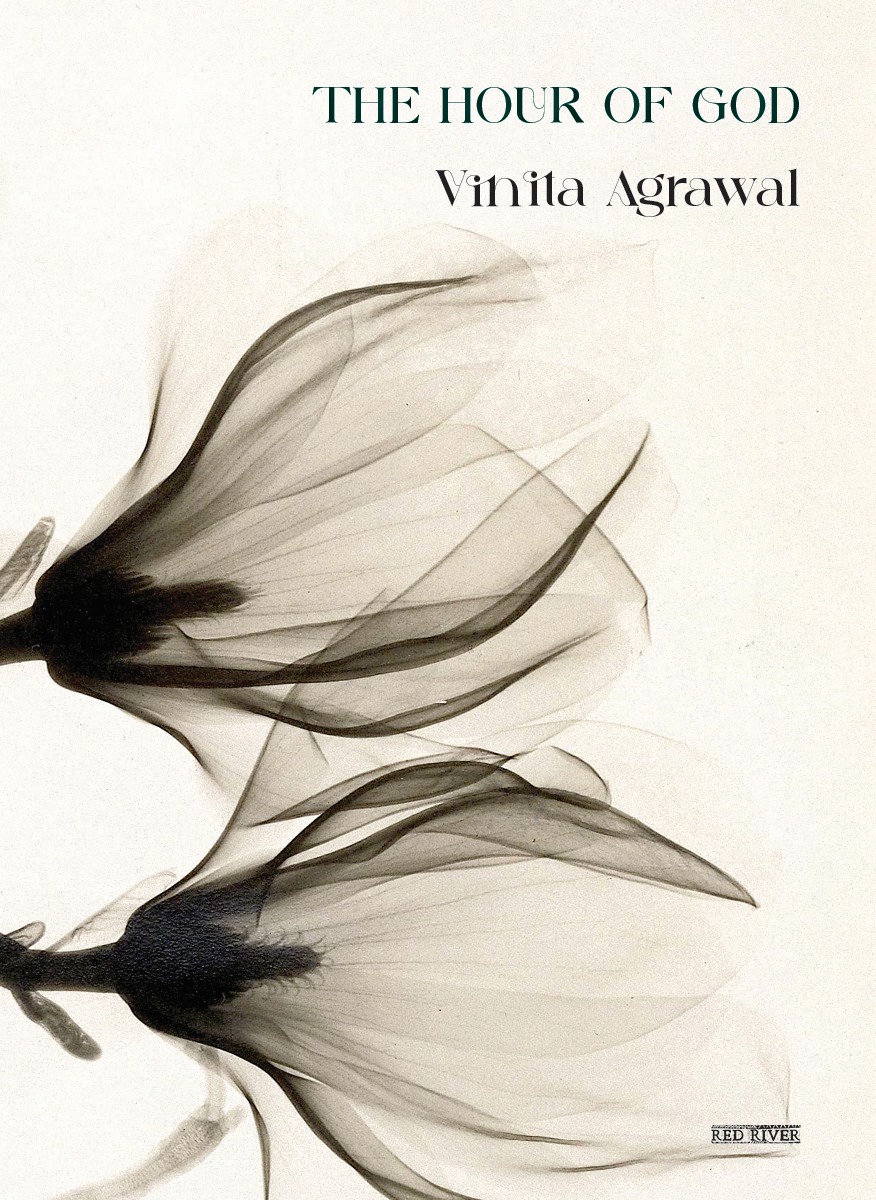
Description
You will learn a lot about how to be in the world, and how to keep you and your soul together, in the poems of The Hour of God. Line by line, stanza by stanza, they deliver a deeply human philosophy, with the lightest of touches. Whether it’s through mourning, or just pausing to appreciate moments of wonder, Vinita Agrawal reminds us of lessons we need to continually relearn through as she puts it, “disengagement, severing, letting go”. In doing so we discover that is how we belong, to ourselves and each other. — Rishi Dastidar
Vinita Agrawal’s poetry is both ecological and metaphysical. As she traverses through worlds stirred by haboob — be they her own interior world of grief, the world of Tibetan exiles or the world of widespread bulbuls and near-extinct vultures, her Rumi spirit of self-awareness shines through. The Hour of God is an inexhaustible pot of exquisite poems from which one must drink one doya at a time, pause to think, and drink again. — Ko Ko Thett
Vinita Agrawal’s poems are sensitive and transporting, guiding us to open our hearts and empathise where we must. Rivers, mountains and flowers are real, particular and expressive in her poems. She writes through a full spectrum — from the heaviness of personal loss and the ‘hard bone of longing’ to the meditative splendour of renewals in the ‘flute of the spine.’ But this responsive poet is also a poet of responsibility. Whether lingering over an injured deer or reflecting about extinct vultures, landless immigrants and the disasters caused by oil spills, she embodies a higher conscience — the mark of a classic poet. — Mani Rao
Vinita Agarwal’s poetry always takes me to a place of tranquil introspection. But in The Hour of God, she leads me in deeper, into an intimate grotto where her poems are like candles whose flames illuminate the deeply personal and the universal, the political and the environmental, the earthly and the spiritual through the wick of image-rich observations. This volume of poetry is about, and I unhesitatingly pluck the words straight out of Vinita’s own poem — ‘The Sun Must be Out’ — ‘reflections and reality/thought and vision/embracing and shedding,’ and it will resonate with readers long after the last page has been turned. — Shikhandin
Vinita Agrawal is based in Indore, India. She holds a MA in political science and a diploma in Computer Applications. She has authored six books of poetry — Words Not Spoken, The Longest Pleasure, The Silk of Hunger, Two Full Moons, Twilight Language and Eartha. Books edited by her include two anthologies on climate change — Open Your Eyes and Count Every Breath, The Centennial Volume on Nissim Ezekiel: Poet & Father and one on the Kashmiri Poet Ghulam Rasool Nazki. She is the recipient of the Jayanta Mahapatra National Award for Literature 2025. Her poem ‘Conversation with a Seed’ won an award at Chrysalis Brew Poetry in 2025. She is runner-up in the Mānoa Poetry Contest 2025. She received a prize for her poem ‘The Light Phenomena’ from Science Fiction and Fantasy Poetry Association (SFPA) in 2025, the Proverse Prize Hong Kong 2021, the Rabindranath Tagore Literary Prize 2018 and the Gayatri GaMarsh Memorial Award for Literary Excellence, USA, 2015. She was long listed for the Kingfisher Poetry Prize 2025. Her book Eartha was longlisted for the Sarojini Naidu Award for Poetry 2025. The book won the YathaKatha Award 2025 and the Voyages of Verse award under the aegis of One Tribune in 2025 and long listed in The Wise Owl Awards. Eartha was also shortlisted for the Pragati-E-Vichaar Literature Festival 2026. She won a special mention in the Hawkers Prize 2019. Her work was shortlisted for the inaugural Dipankar Khiwani Memorial prize 2021. She co-edits the Yearbook series of Indian Poetry in English. She was former Poetry Editor with Usawa Literary Review. Her work has been widely published and anthologised. She is on the Advisory Board of the Tagore Literary Prize. She is the author of a children’s fiction book Jade and the Harmony Flyers (Bare Bones Publishing). Her work has been published in Global South, Pratik, Mascara Review, Indian Literature, Asian Cha, Voice and Verse, Tiger Moth Review, The Bombay Literary Magazine and the Knopf Newsletter, Canary, Tabula Rasa, Parcham, Chrysalis Brew, SFPA, Blue Mountain Review and Madras Courier, among others. She has read at several festivals in India and at the Filey festival in Mexico. She is one of the twenty poets to be featured in a documentary on Asian poets titled Deepest Uprising made in Taiwan. She is a birder and a photographer. She has deep compassion for animals and a genuine love for nature. www.vinitawords.com.
FROM THE BOOK
Guard the Hour of God
Guard the Hour like a vigil.
Guard it from distraction and dogma,
from hurry and the habitual,
from the glance that skims the surface
and the gaze that presumes to own.
Guard the Hour like a clearing.
Guard it from the calculated storm,
from the charlatan’s grin and the cynic’s shrug,
from polished rhetoric
and the dissecting lens.
Guard the Hour as an aperture.
Guard it from false prophets, familiar scripts,
from the neutron star’s cold pull,
from saccharine devotion
and the autopsy of faith.
Guard the Hour as arrival.
Guard it from the blaze that blinds
from the violence done to wonder,
from the packaged pilgrimage
and the frantic demand for epiphany.
Guard the Hour as a truth.
Guard it from the corrosion of doubt,
from the varnish of tradition thick over the living pulse,
from the dew that promises revelation but only chills
and the brokers trading cheap certitude.
Guard the Hour as a threshold.
Guard it from the idol carved of doctrine,
from the weight of Uppercase Decrees,
from the inheritance of fear
and from the Hour’s own unbearable, annihilating light.
Guard the Hour as a surrender.
Guard it from the silent fractures within the waiting soul,
and the well-worn rut of ritual
and the grime of commerce,
and the winter of the heart.
and yes —
Guard it fiercely from the name ‘God’ itself.
Ma
Let time be sandpaper,
wearing slow your grain, Ma —
coarse, at first,
then sleek as marble.
You are the trace-line, Ma
where moss writes
its green psalms.
What Is the Word
for
a pool beneath a waterfall
the shape of a bend in a river
a heart, clenched and heavy, holding rain
tomorrow‘s numbness waiting in the wings
beaten skin
bruised breaths
hollow hours
hugs contusions give themselves
days where sunlight does not reach
seeing oneself on a stranger’s bookshelf
the key that returns you home
the sound of mother humming?
Homeland
Roots grip deep in contested dirt.
This anchor, this ache.
A name whispered into cracked walls,
mother’s voice in the stones.
Not an open sky, but a known weight.
The shape your shadow carves.
Metal that remembers your name,
cold against warm skin.
Stubborn stain on the palm,
earth under the nail.
The song hummed when the road calls loudest.
The unsung verse.
The question answered
only by standing where your bones settled.
Where the earth knows your weight,
roots deep as graves.
Reviews
Meet Vinita Agrawal in Bold Journey
Book Excerpt: Reflections On Time And Impermanence in Outlook
The poems in the collection ‘The Hour of God’ offer a poignant reflection on the reciprocal relationship between humanity and the world. They engage deeply with our planet, acknowledging both its wounds and its potential.
‘One swallow / the earth remembers rain’: Poems on shared experiences in late-stage capitalism. An excerpt in Scroll
Read an extract in Usawa
Alka Balain in The Hooghly Review
Vinita Agrawal’s The Hour of God unfolds in a quieter, more diffused Hour—the Brahma Muhurta. Rather than dramatizing such a decisive descent, the poems dwell in the sacredness of the hour, a time of awakening and well-being. The title recalls Sri Aurobindo’s Hour of God where certain moments mark an intense descent of Grace, demanding readiness and offering the possibility of effortless results. This distinction is subtle, yet significant.
Rachna Singh, editor, The Wise Owl talks to Vinita Agrawal in The Wise Owl
“I’m afraid poetry does little on the actual ground of construction, and exploitation but the good news is that it does a lot in sensitising the readers and the public. It brings about awareness and empathy. It helps towards creating pressure groups that bring about actual change. I’m a firm believer that if the microcosm changes, the macrocosm changes automatically. This means that if one, individual mind changes for the better then that multiplies manifold and society as a whole also changes positively. In that sense poetry becomes the right vehicle for carrying the right message.”
Shabnam Mirchandani in The Bangalore Review
The poems in this collection are a cartography of trails through the loam of existential wilderness. Vinita traces breath’s sojourn through earth’s body with the vibratory resonance of ancient mantras, an archive of human longing scripted into its invisible membranes. Like salt in tears, word crystals flow with trembling quietude as each page unfurls its message in baptismal ink. This alchemical covenant of poesy stems from a strangely holy abandon, where liberation of fugitive instincts enables her soul’s soaring choir to defy the ontological traps of consumerist modernity. Such is the inspirational trance that drives Vinita’s poetic inclination to part semantic veils and taste the feral lineage of silence. Vinita’s utterances then emerge fire-winged, out of subterranean grief. Riding flames of melancholic intensity, they cascade luminously in the form of emotionally charged epistles to the universe: a cadenced spectrum ignited by a mesmeric constellation of revelations. This mosaic of choice and chance, with its tortured witnessing of oppressive socio-political hegemonies, and its fractured spiritual light forms her praxis of radical healing through poeisis. As an eco-satva attuned to the archetypal matrix, Vinita channels her greenly fertile lyrical energy, drawing from the hermetic wisdom of creaturely minutiae, the sensorial caverns of memory’s dimly lit pathways, and the silken mysterium of the heart’s tender hope.
Candice Louisa Daquin in Austin Poetry Review
The Hour of God conjures a voice imbued with many traditions and cultures, the sounds of other worlds rippling like song, with interspersed rhythmical colors rising and falling like variegated skirts rubbing against fruit.
Sayan Aich Bhowmik in Parcham
Most poetry collections have an underlying trope that runs through them—an image, a word, an idea. In Agrawal’s, it is that of light. Light appears in various manifestations, sometimes as necessitated with dealing with the past, as in the poem Before the Ancestral Home, where the past is a note of unfamiliarity that time and brings and “light is a blade of memory.” Her language and images flow seamlessly as if one spirit, moving from one room to the other, through past and present. In Stroke, we have “windows closing to light,” and in Conversation with a Seed, the poetic voice sees itself as “the quiet conversation the earth repeats with light.” There are multiple such examples and I would leave it to the readers to uncover the underlying repository of meaning and suggestiveness which these images carry. But light is everywhere in these poems, shining through, illuminating and providing an awareness of the self—for clarity, knowledge, self-realization and truth.


