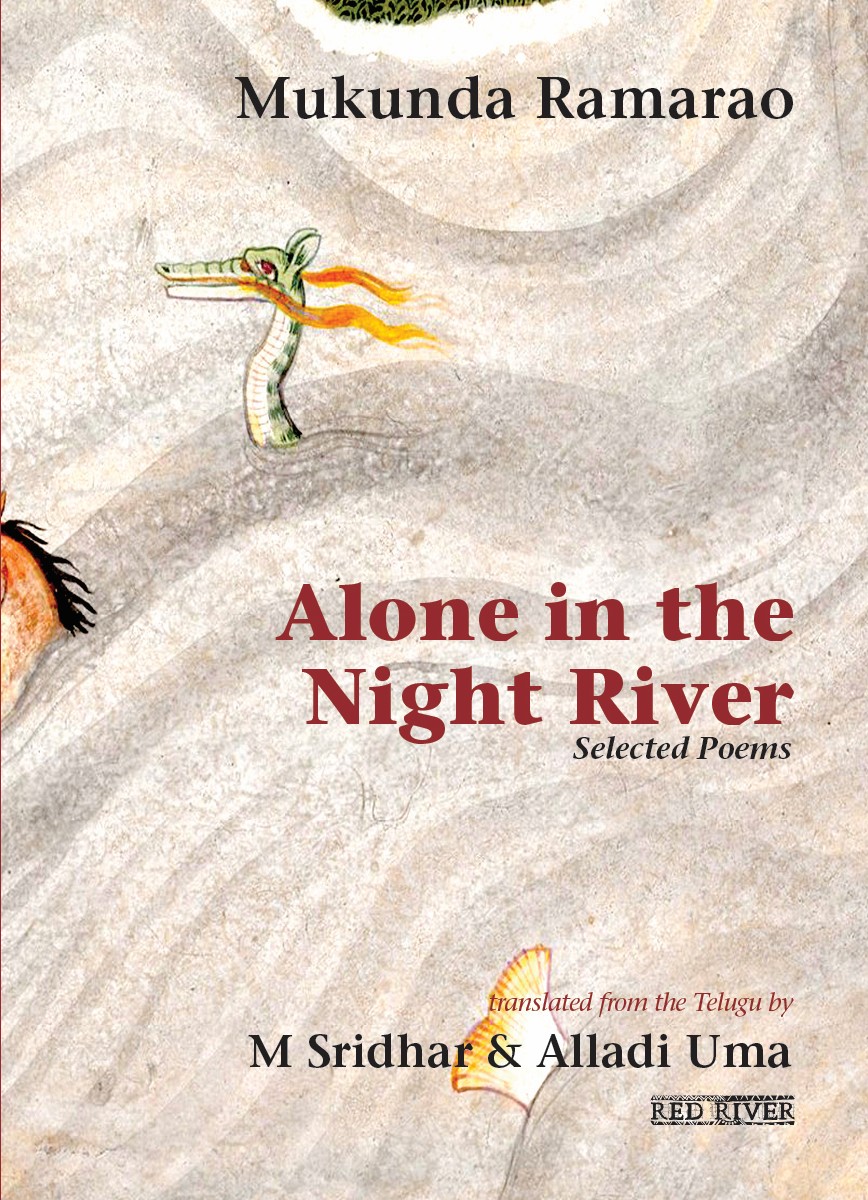
Description
I am alone in the night river
I am searching
for myself
in waves
in dreams
in everything
Mukunda Ramarao’s poetry seems to be an interesting blend of belief in the cycles of life and an existential viewpoint. In this world, in this life, we are all migrant travellers. This feeling of alienation is brought about by the ‘sadness of painful impermanence’ that we all feel once we are born. ‘No matter how long one lives’, or where one does, one is always ‘an immigrant, a traveller, an outsider.’ — GJV Prasad, from the foreword
Mukunda Ramarao is very different from all the poets we have translated so far. He is far from political, a genre with which we have been most comfortable, where the meaning of what is being said is clearly enunciated. His poems are for the most part reflections on natural phenomena — water, river, a cloud, a mountain, light, day, night, darkness, sunset, sunrise — reflections on human behaviour — of a daughter, of a grandchild, of a grandfather — and philosophical ruminations on life about which we had no particular faith nor serious reservations. Or sometimes it is just a turn of phrase that turns the poem into something deeply reflective as in the poem, ‘Inside Outside,’ or an image as in the poem, ‘Rain’ that ends with the lines: ‘Earth has been dancing/ from times immemorial/ hanging like a puppet/ on the strings of the rain/ naked/ courageously/ in hope.’ Translating a poet so different certainly meant our maintaining a sense of objectivity, a measure of distance or detachment so as to view them all from the poet’s perspective. — M Sridhar & Alladi Uma, from the translator’s note
Mukunda Ramarao (b 1944) is a poet, translator, short story writer and essayist. He has nine Telugu poetry collections to his credit. His poems have been translated into many Indian and international languages such as English and Polish. He has translated extensively into Telugu and published fifteen books. His major contribution in translation has been to bring into Telugu the poems of Nobel Prize winners. Among the prestigious awards he has received are the Telugu University Kirti Puraskaram for best poetry in 2008, Telugu University Sahitya Puraskaram for best translation in 2017, and the Lifetime Achievement Award in Literature from Ajo-Vibho-Kandalam Foundation, 2024.
M Sridhar and Alladi Uma have been translating from Telugu to English, and English to Telugu for over 30 years, mainly with a focus on the issues of class, caste and gender. Their translations have come out from leading publishing houses such as Orient Blackswan, Sahitya Akademi, Katha, Stree/Samya, Ratna Books and HarperCollins. For their contribution to the field of translation they received, among others, the Rentala Memorial Award (2006), the Malathi Pramada Sahithi Puraskaram (2018), and the Laadli Media Award for gender sensitivity in translation (2022). They retired from the Department of English, University of Hyderabad. They are associated with The Alladi Memorial Trust, Hyderabad, that takes care of the legal, educational and medical needs of the underprivileged.
Reviews
Resmi Revindran in Saranga
Alone in the Night River is an exceptionally apt title, as every poem in this collection carries a palpable sense of motion. They feel like observations penned by someone in a state of perpetual transit. The river flows, the night is equally ephemeral, and the poems arrive as distilled wisdom from a traveller who has reached the end of a long, eventful journey, yet remains prepared to embark upon new adventures toward unlit and unknown horizons.
Kabir Deb in Indian Literature, Jan-Feb 2026
Poetry, as a medium, is made up of two important agents of human mind: vision and language. It does not imply that other species living on planet Earth are devoid of languages. The difference lies in how we process and implement a language to give it the shape that can be both mysterious and bare to all. Like George Bernard Shaw said, you use a glass mirror to see your face; you use works of art to see your soul, the objective of poets has always been to introduce their souls because the genre goes beyond mere visibility. It has something more to say which is not ordinary. … Mukunda Ramarao’s Alone in the Night River: Selected Poems, translated from the Telugu by M Sridhar and Alladi Uma (comprising of poems selected from the nine poetry collection published by Ramarao in Telugu), is a text where the avoidable and redundant constituents of our daily life turn into the poet’s bigger picture. The title itself is an illusion since even the word alone has a larger meaning in the book. One can simply remember Shaw’s quote that communication isn’t always about what has taken place, it is an illusion we built.


