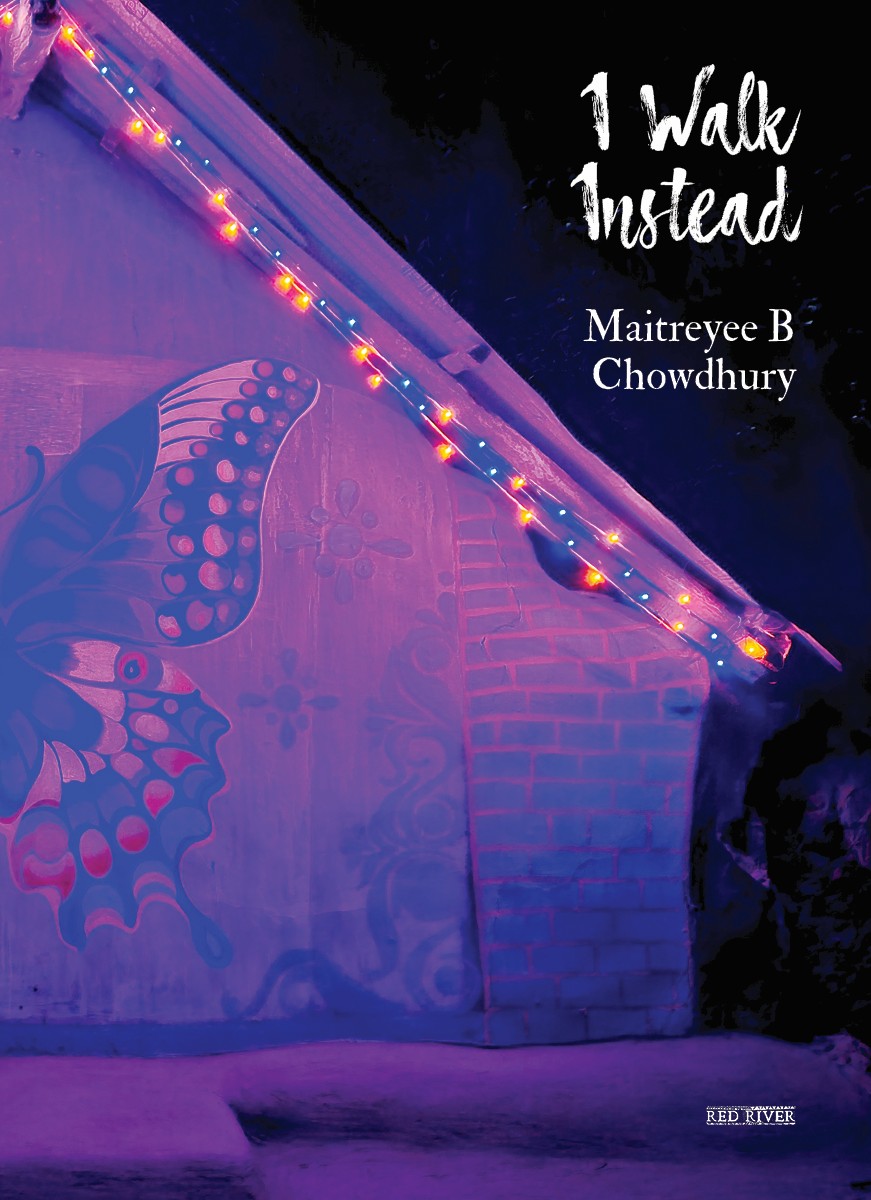
Description
People often tend to walk away from others, from circumstances or from places — my walks were all of that, and yet, the more I walked, I realised that it was people I was coming back to. With this realisation came the understanding that the act of walking is not only slower, but also grounded by the physical contact that it allows. Often on my walks, especially across Madhya Pradesh, I realised that in this country you are rarely alone. Unlike the city, the rural landscape feels vast and sparse. People stop to stare at you here, many ask whether you are on a Parikrama (a religious walk), something I was quick to adapt to, because it gave a sort of legitimacy to a woman walking alone. I have walked relentlessly through harsh landscapes, through the river banks of Narmada and Betwa, along parts of the infamous land of Chambal, inside forts and along the busy streets of many Indian cities. I have no idea really why I walk, and what it is that I might be in search of, other than my eternal curiosity of meeting the new. The stillness of the roads becomes addictive beyond a point and then there is the headiness of seeing the unexpected. — Maitreyee B Chowdhury
Sensuous and startling, Maitreyee B Chowdhury’s I Walk Instead invites us to keep pace with her padayatra journey that crisscrosses the continent. Mandu to Mylapore, holy rivers to shanties, and at all times with nature, she sings their histories, solitudes and specialness into new being. Her ‘temporary maps’ shape into spiritually and politically sharp poems, always attentive to the ignored. Each poem, you find, morphs into your own shrine of belonging. — Priya Sarukkai Chabria
Maitreyee B Chowdhury’s poems are that fated, restless journey between the heart and the heel. It is both a confrontation and an escape. The constant movement defines the rhythm and course of her poems. The sights in her walks are ‘tattooed into her flesh.’ No river cleanses her completely. No road ends in a home. Her poems seek to report the state of her world; she measures it with her words — and her feet. — CP Surendran
Maitreyee B Chowdhury is a poet and writer. She has authored Uttam Kumar and Suchitra Sen: Bengali Cinema’s First Couple, Where Even the Present is Ancient: Benaras, One Dozen by Hasan Azizul Huq (translation), and The Hungryalists. Uttam Kumar and Suchitra Sen: Bengali Cinema’s First Couple was shortlisted for the Crossword Awards (non-fiction). Maitreyee is the editor of the literary journal The Bangalore Review and one of the founding members of The Bengaluru Poetry Festival. She has been widely published in national and international journals.
Reviews
I Walk Instead and 3 Other Poems. A poignant exploration of ancestral landscapes as contested spaces of belonging, unearthing profound resilience and sorrow, while asserting voice against historical erasure. In Usawa.
Mani Rao in Asian Cha
Maitreyee B Chowdhury’s fifth book I Walk Instead is a collection of poems inspired by her visits to places across India, on foot. … The startling, jazzy poems in this book draw upon the land, its rivers and the life beside them, and upon the witnessing presence of people (and birds, and flowers, and trees, and scents, and colours) to tell several stories both poignant and delightful.
Kabir Deb in his Substack
Maitreyee B. Chowdhury’s collection emerges from the depths of the human soul while remaining firmly grounded in the landscapes she walks through. These poems are shaped by attentive observation, where places, people, memories, and fleeting encounters are not merely noticed but deeply felt. Chowdhury grazes the grass to taste it completely and not just feel the surface. The recurring textures of longing, solitude, desire, and remembrance lend the collection an unsettling quality, yet that very unease makes it compelling and necessary. While the language may at times appear irregular and the references demanding, the true strength of the book lies in its distinctive voice that’s reflective and unafraid of complexity.
Shantanu Ray Chaudhuri in his website
I Walk Instead is a remarkable collection that transforms walking into an act of witnessing, remembering and becoming. Every poem in this beautifully produced volume is a journey through landscapes both external and interior, through cities, forests, rivers, forgotten neighbourhoods, railway stations, villages and coastlines, but equally through love, grief, migration, memory and the endlessly shifting idea of home. The result is one of the most compelling contemporary Indian poetry collections in recent years, a book that rewards slow reading and repeated returns.
FROM THE BOOK
Dihing: A Shape-Shifting Water
The geography of my childhood
is limited to two thusa trees, a few red-winged birds
and endless blue-green valleys.
The geography of adulthood meanders through a disobedient river,
shadow people and guns on a crimson dusk.
Time had taught us to become water runners,
walking backwards
through graves the size of a pillow.
Soon, we drowned all songs that spelt of home
became algae — dead fish and islands of Rabha songs.
The Dihing is a shape-shifting water, garrulous and political —
terrifying whispers pass through it,
and stories that must never be told.
On these waters,
memory becomes a story-keeper,
and remembrance, an ephemeral cloudiness.
Chitto Babu’s Chicken Stew
Almost every office day starts with a good chicken stew
at Chitto Babu’s place in Dacres Lane.
Crunchy loaf, bowls of chicken thighs,
raw papaya, round potatoes,
green beans and pepper floating in plastic bowls
with butter on the side.
‘Good beginnings’, someone whispers
from an old wooden bench.
I nod my head, close my eyes
and suddenly it is 1947
all over again.
Astral Conjunctions
Gandhara sculptures from Mathura —
yakshas, yakshinis,
large breasts, massive penis —
all there on display at the Indian Museum.
It is December of 2016 —
under the effect of astral conjunctions,
I imagine growth,
and its fall,
now weighed down in cement —
like the serpent positioned on Buddha’s lean arms,
latticework in stone — I tell myself,
or a reimagining of Indian myths.
Either way,
to find a character hidden within the fables,
the present sometimes feels like a walk
through the ancient.


