Description
Here in this fishing village/ with its singing temple by the sea/ a thousand daughters rise.// The shore stretches long in the early light./ Kamya chants hari bol.// Coconut palm grows tall by the ocean./ Green fruit ripens slowly,/ full of milk and water.
In her first poetry collection, Sri Lal evokes the myth and humanity of coastal village life in South India. Lal writes with sensitivity about the complex struggles of being a woman, as she gives voice to mothers, daughters, sisters, and wives. Their myriad experiences ebb and flow like the tides of the Arabian Sea, which also arises as a central voice in the collection. Passion and longing are tempered by a current of intergenerational wisdom that grows stronger with self-discovery. A glimpse of the mystical runs throughout. These lyrical writings are a collective coming of age story for the archetypal woman, as the poems explore female strength and vulnerability through the changing seasons of rural life.
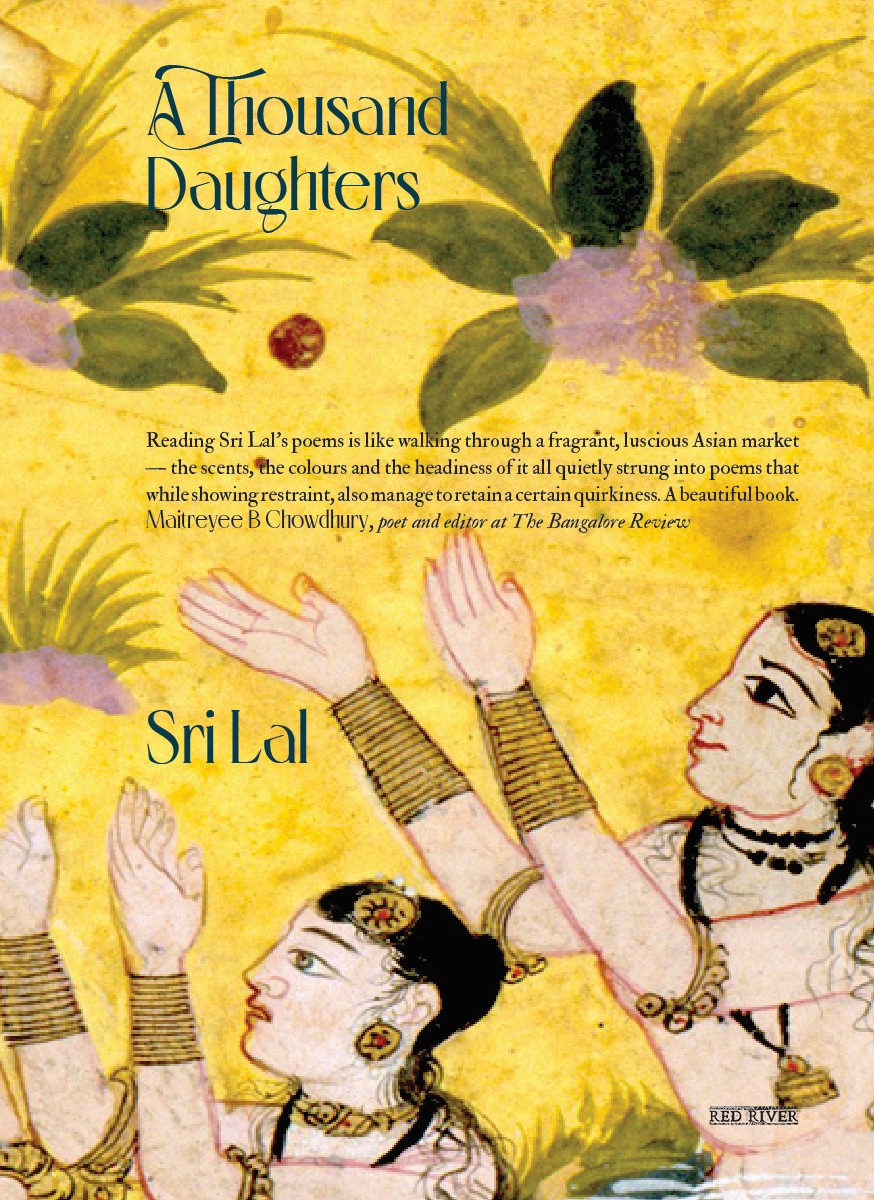
Reading Sri Lal’s poems is like walking through a fragrant, luscious Asian market — the scents, the colours and the headiness of it all quietly strung into poems that while showing restraint, also manage to retain a certain quirkiness. A beautiful book. — Maitreyee B Chowdhury, poet and editor at The Bangalore Review
Sri Lal is a mystic, yogini, and poet. She often writes on themes of rite and cultural memory through a lens of Indian philosophy. Born beneath the waxing moon of Jyestha, she received mantra initiation in the Vedic tradition as a small child. She has also been deeply influenced by Sufism and Christianity. After her grandmother died, she made several pilgrimages, visiting temples and saints to reconnect with a deeper truth. She now resides in New York City, where she has served in hospitals, prisons, women’s shelters, and at the United Nations. She is currently working on a project to preserve ancient spiritual manuscripts. She teaches in the English Department at the City University of New York.
Reviews
Vedamini Vikram in PYSSUM Literaria
There is a word in our language that has almost calcified with use — “daughter.” It arrives pre-loaded with virtue, coddling, “save the girl child” campaigns and education drives, forever synonymous with selflessness and goodness. “Son”, in contrast, still carries the older, harder gendered weight—valor, sons of Poseidon, Dharti ke Lal, patriotism ingrained into the very sound of the word. The critique of this dichotomy has, by now, become almost tiresome in its familiarity. Every generation has explored the same argument in slightly different language. What Sri Lal does in A Thousand Daughters is something rarer: she doesn’t argue with the word at all. She simply widens it until the old argument no longer fits inside it. Here, “daughter” stops being a single fixed identity and becomes something closer to an ancient, elastic term, capable of holding a mystic, prodigious figure and an ordinary girl in the same breath, never settling into one meaning for long. A thousand meanings emerge across the collection, a thousand stories, a thousand daughters rising, not in protest or a power struggle, but quietly, spiritually, often intimately, but powerfully. Sri Lal blends the coastal mystique of ocean and coconut and tree with the hush of a diya’s flame and the ringing of temple bells, moving through the book the way a raga moves through its interludes, each poem a glimpse of an inner and outer being. To read it is a strangely, almost disturbingly calming experience.


